Exercise induces the release of a hormone called irisin, which converts white fat into thermogenic (calorie-burning) brown fat, according to a new paper published Wednesday in Nature. They motivate the paper by saying, "Exercise has the capacity to improve metabolic status in obesity and type 2 diabetes, but the mechanisms are poorly understood. Importantly, exercise increases whole body energy expenditure beyond the calories used in the actual work performed." The paper begins to explain how it may be that exercise burns more calories than those in the actual work: that is, much research in the exercise science literature finds that anaerobic exercise (like strength training and high intensity intervals) burns calories for 48 hours afterwards. Perhaps this hormone begins to explain why.
Meanwhile everyone is still despairing slightly because of the NYT Magazine article suggesting that body weight setpoints make permanent weight loss very difficult for almost everyone. The article mostly quoted people who used very low calorie diets that induce starvation conditions and steady-state cardio. As many have noted, steady state cardio doesn't work. People who stay away from processed food and use high-intensity intervals and strength training may have more luck maintaining weight loss.
If I understand the biochemistry, other research already found that high-intensity exercise increases a related protein (e.g., as found in Tabata's paper, famous for his intervals). We already know that anaerobic exercises burn more calories for longer and result in greater fat loss and less muscle loss. This paper suggests why: anaerobic exercise may be most effective in converting white fat into brown fat.
I am disappointed not to see a practical conclusion --- more weight lifting and intervals, less low-calorie dieting --- in the NYT Magazine article. The message is still "just walk more", which clearly doesn't work, but people say it because it seems realistic and attainable (never mind that it's cold outside.) Instead "do something hard" might result in people pushing themselves more and gaining more of the benefits of exercise demonstrated in this paper. I wonder what state the science would have to be in before the messaging on exercise changes.
After reading the paper, I did 3 simple Tabata intervals, and from this paper now I know that the irisin makes it worthwhile.
Showing posts with label nutrition. Show all posts
Showing posts with label nutrition. Show all posts
Friday, January 13, 2012

Sunday, November 27, 2011
Gluten-free processed foods for the masses
NY Times published today a fluff piece whose title posed the question whether everyone should go gluten free. Rather than addressing the question in the title, they gave a portrait of a processed food company's endeavor to address this niche market.
I wish they had addressed the question of gluten posed in the title. I'm also baffled by the claim that there's no gluten-free food --- there's plenty of gluten-free food in every single supermarket, and there always has been. The types of processed foods that they address in the article should comprise no more than a few percent of a person's diet. Celiacs used to be lucky for being forced to eschew the processed food-like products that have taken over the standard American diet, such as breakfast cereal, canned soups, cookies, crackers, and frozen foods. With greater quantities of gluten-free processed foods, they are free to be as unhealthy as anyone else.
I wish they had addressed the question of gluten posed in the title. I'm also baffled by the claim that there's no gluten-free food --- there's plenty of gluten-free food in every single supermarket, and there always has been. The types of processed foods that they address in the article should comprise no more than a few percent of a person's diet. Celiacs used to be lucky for being forced to eschew the processed food-like products that have taken over the standard American diet, such as breakfast cereal, canned soups, cookies, crackers, and frozen foods. With greater quantities of gluten-free processed foods, they are free to be as unhealthy as anyone else.
Tuesday, June 28, 2011
Medical system biases
A respectably sized randomized trial finds transcendental meditation has enormous effects on heart attack mortality, decreasing by half. Among the most vulnerable or the most involved in meditation, mortality decreased by 2/3rds. That would be huge even for a drug. As one of the study authors said, "The effect is as large or larger than major categories of drug treatment for cardiovascular disease."
Nonetheless, in spite of the much larger effect from meditation than any drug therapy, the article paraphrases the researchers as saying that the meditation should complement rather than replace drug treatment. If we believe that randomized trials yield correct information that can be used for treatment, why limit the results in this way?
Yes, the results need to be replicated a few times in different populations, etc., but my suspicion is that even after they are replicated (possibly with smaller effect sizes), the "don't stop taking drugs" message will remain.
Given recent results about increased risk of type 2 diabetes from statins and indications of memory problems from statins, those who advocate drugs need to defend their choice more. It seems that there's an implicit bias that treatment within the medical system must be healthier. Similar to the implicit bias against fat that caused Ancel Keys's views to prevail; now new studies that low-fat diets contribute to unhealthy weight gain are rarely publicized.
UPDATE: Now the article has been held back from publication due to last minute data, and the Telegraph took down the article. Wonder why.
Friday, May 27, 2011
Changing biomarkers may not reduce disease risk
A drug that successfully raises HDL and lowers triglycerides does not reduce heart disease risk. One scientist quoted in the NY Times said that this study indicates that changing biomarkers for disease is not the same thing as preventing the disease. While obvious to many people outside the biomedical world, it's lovely to hear someone from the biomedical complex say that.
Oddly, many folks quoted in the article said that regardless of the study, people should still take the drug or at least talk with their doctor about discontinuing it. Which is a lot like what came out of the National Preventive Services Task Force's report about mammograms for younger women: we want to learn from evidence, but not shake things up.
Throughout the article, different people kept saying that the study implies that raising HDL does not improve heart disease risk, but really they seemed to mean that raising HDL through drugs doesn't work, but as far as I know raising it through exercise and diet does improve heart disease risk.
Everyone already knows the answer: stop eating processed food, start cooking, and exercise. There are no easy answers, but I think that Men's Health magazine has better heart disease prevention than most medical journals. The sooner we get past the nutritional fads that elevate processed foods above unprocessed foods, and use drugs as a short-cut, the healthier we'll be. Isn't it crazy that during the 90s, people saw coconut and chicken with skin and whole milk as dangerous, and pasta and bread and low fat sweetened yogurt as healthy?
Monday, May 24, 2010
Anecdote vs. data: soda taxes
I'm constantly amazed how many people doubt that tobacco taxes and soda taxes work, even people who are educated and listen to empirical research in other parts of their lives. The reasoning seems to be that because they don't feel particularly price sensitive --- making purchase/quantity decisions based on goods' prices --- they aren't price sensitive. Likewise, because they have seen people continue to smoke and buy cigarettes at high prices, they believe few people are smoking less or quitting smoking due to tobacco taxes.
Campaign for Tobacco Free Kids put out a new report on this subject, documenting simultaneous decrease in smoking and increase in revenues from tobacco taxes. The economic research on the subject indicates that soda taxes could be similarly effective.
Going the other way, many people don't perceive expensive produce as a barrier to produce consumption. If they choose to buy more expensive produce (e.g., shopping at a more expensive store, only organic/local), they don't see that their decision to buy more expensive produce could decrease their fruit and vegetable consumption. At most levels of income, probably they will buy less if the produce costs more. Certainly they would buy more if it were cheaper: I've noticed that yelp reviews of lower cost produce shops and supermarkets commonly remark that they can get several huge bags of produce for the cost of one bag of produce at their regular store, and that they do get more when they shop at these stores (e.g., this one in Chicago).
People who otherwise listen to economic research and use it to guide decisions and opinions in the rest of their lives, and who believe in things that they can't see like germs, atoms, and molecules, somehow don't believe in price elasticity because they can't see it. I wonder if anyone's researched the impact of belief in price elasticity on economic behavior.
Sunday, September 6, 2009
David Kessler's The End of Overeating
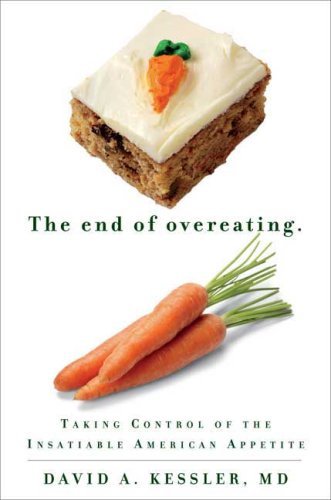
I remember when David Kessler became head of the FDA when I was in middle school. As an MD with a JD, he was a model for combining policy interests with scientific knowledge of health. In my middle school judgement, I found what he said incredibly sensible and just plain smart, and I decided that I should also get an MD/JD so I could grow up to be David Kessler.
Middle school judgements are sometimes exaggerated, but his book The End of Overeating does not disappoint in terms of the breadth of information that it tries to integrate. Kessler combines both human and animal research, frank and sometimes shocking conversations with food consultants revealing the secrets of increasing consumption (e.g., soft drink companies attempting to induce people to drink less water), and a food travelogue to create a compelling story to explain American obesity. For instance, Kessler discusses methods of food manufacture that causes processed restaurant chain food to break down the protein structure of meat and inject marinade so that it can be consumed more quickly than standard meat.
One of his central points is that sugar, salt, and fat combine to make food compelling ("hyperpalatable"), but he treats these elements as if they are interchangeable, but all hyperpalatable foods that he gives as examples have elements with a high glycemic index (breading, sugar, etc.) and the nutrition literature recognizes a distinction between fat and sugar. For instance, rats will overeat on pure sugar, pure fat, and sugar/fat mixtures, but only fat or sugar/fat mixtures increases weight but rats don't gain weight on sugar (one area in which they're clearly different from people --- witness the Snackwells effect which he mentions as well). Rats have few problems discontinuing fat, but discontinuation from sugar causes withdrawal symptoms similar to opioid withdrawal. (Avena NM, Rada P, Hoebel BG. Sugar and fat bingeing have notable differences in addictive-like behavior. J Nutr. 2009 Mar;139(3):623-8. Epub 2009 Jan 28.)
His theory and examples are also disjointed from each other. To bolster his claim that sugar alone is not enough to create hyperpalatability, he describes experiments in which people find skim milk with sugar added unpalatable but really like cream with sugar added, but then he contradicts this theory by describing his own struggles that lead him to eat an entire box of Snackwells fat-free cookies in a short period.
A theory based on macronutrients has extreme limits. While he does talk about flavor with food consultants, he doesn't incorporate flavor into his theory; obviously flavor is complicated. In a few places he says that obviously sugar in the absence of fat isn't a problem because people aren't eating sugar straight out of the bag, not considering that it's not exactly common to see people drinking oil out of the bottle or eating sticks of butter. Flavor is of course the important moderator: people will eat large numbers of meringues, jelly beans, angel food cake, Snackwell cookies, and all sorts of high calorie fat free foods, just as they will eat bacon (and I can't think of any other examples of fatty foods that derive nearly 100% of their calories from fat, to be comparable to jelly beans). An interesting counterpoint would be if he performed experiments in which he tested consumption of food in the absence of flavor, such by wearing noseplugs, as Seth Roberts has experimented with on a small scale.
He makes some strange claims about people historically eating low-fat meat and cites USDA data that people eat more fat than ever before, though other USDA data says that fat consumption has decreased since the 1970s and only sugar consumption has increased.
The book's chapters were short and did not tie together well, so his argument came off as more simplistic and repetitive than if he had written longer chapters that would have necessarily tied his argument together well. Even the short chapters sometimes ended abruptly. For instance, he has a chapter about Cinnabon, the 730 calorie pastry (sidenote: I remember from the only time I had a Cinnabon sometime in middle school that it had 500 calories and being horrified; I decided to check that calorie count again, and in fact now it's 730. Now that 500 calorie cookies are common, Cinnabons had to become 50% larger than before!) He interviews the creator of the Cinnabon and reveals that she had second thoughts about her creation, echoing Cookie Monster's refrain that "cookies are a sometimes food", and that she had created the Cinnabon to be a treat. He adds in a tantalizing last detail that she used to suffer from eating disorders and was unable to distinguish hunger from other needs, but then he ends the chapter abruptly without relating her eating disorder to her second thoughts about having created the Cinnabon.
The chapters about how to resist food are not new and have been covered better elsewhere such as in Brian Wansink's Mindless Eating as well as of course in the literature.
The book does add to the plausible explanations for the rise of obesity in the US, and it's well worth taking an afternoon to read this book. The quotes from food consultants about how to create "irresistible" and multi-layered "eating experiences" ("eatertainment") were especially revealing of the great deal of effort food companies have exerted to produce American obesity.
Friday, June 19, 2009
Obesity and "light" food
Some people have speculated that the idea of light or reduced calorie food is partially responsible for the obesity epidemic, but usually with regard to processed food with the famous ``Snackwells effect'': people eat a whole box of low fat cookies instead of 2 Oreos.
I started thinking about that after baking a cheesecake. I used this recipe from Rose Levy Birnbaum with full fat cream cheese and sour cream but no crust because I grew up without pie crusts. I never have foods like full-fat cream cheese and sour cream in the house and I felt so decadent buying them and putting them all in a bowl together, so it was with a morbid curiosity that I decided to compute the calories: 12 slices = 240 calories each, 8 servings = 350 each. If I'd used Neufchatel cheese which is an almost invisible substitution, 8 servings = 300 each.
That didn't seem like many calories, so I decided to compare a light cheesecake I'd recently heard about from the Best Light Recipe. The light recipe uses cottage cheese, yogurt, and Neufchatel cheese, so clearly they must save some calories, yet according to their calculations the cheesecake serves 12 and has 340 calories in each slice, 100 calories more than Birnbaum's recipe. Both recipes get made in a 9 inch dish. Maybe slices of the Best Recipe are marginally taller, but like glass width I'm guessing that's the type of size difference that people don't perceive readily.
So it's not just the Snackwells effect: the low-fat version doesn't even have less calories, and could have more. I've made my decision: when it comes to dessert, full fat only. The rest of the time I can scrimp and use 1 T oil when the recipe calls for 1/4 c.
Here's my calculation of the Birnbaum cheesecake calories for those who want to check my math:
Total calories: 2855 (2375 if Neufchatel cheese).
I started thinking about that after baking a cheesecake. I used this recipe from Rose Levy Birnbaum with full fat cream cheese and sour cream but no crust because I grew up without pie crusts. I never have foods like full-fat cream cheese and sour cream in the house and I felt so decadent buying them and putting them all in a bowl together, so it was with a morbid curiosity that I decided to compute the calories: 12 slices = 240 calories each, 8 servings = 350 each. If I'd used Neufchatel cheese which is an almost invisible substitution, 8 servings = 300 each.
That didn't seem like many calories, so I decided to compare a light cheesecake I'd recently heard about from the Best Light Recipe. The light recipe uses cottage cheese, yogurt, and Neufchatel cheese, so clearly they must save some calories, yet according to their calculations the cheesecake serves 12 and has 340 calories in each slice, 100 calories more than Birnbaum's recipe. Both recipes get made in a 9 inch dish. Maybe slices of the Best Recipe are marginally taller, but like glass width I'm guessing that's the type of size difference that people don't perceive readily.
So it's not just the Snackwells effect: the low-fat version doesn't even have less calories, and could have more. I've made my decision: when it comes to dessert, full fat only. The rest of the time I can scrimp and use 1 T oil when the recipe calls for 1/4 c.
Here's my calculation of the Birnbaum cheesecake calories for those who want to check my math:
- 1 lb cream cheese, 1600 (1120 if Neufchatel cheese)
- 1 c brown sugar, 829 (774 if white sugar)
- 1 T cornstarch,
- 3 eggs, 225
- 1/2 T vanilla
- 1/4 t salt
- 1 lb sour cream, 900
Total calories: 2855 (2375 if Neufchatel cheese).
Wednesday, May 28, 2008
Effects of food subsidies on nutrition in China
In introductory economics in grad school, which I took with Nolan Miller, we read his co-authored paper on why rice is a Giffen good in Hunan, China --- that is, rice is a good for which when price increases, consumption increases as well. Increased rice prices crowd out the more expensive sources of calories, so more calories come from the cheapest source of calories, and rice consumption increases. Likewise, they find that in parts of China where noodles are the basis of the diet, noodles are the Giffen good.
Nolan and Jensen have updated their work now to study whether price subsidies improve the nutrition of the poor in China. They find that the quality of nutrition does not improve with subsidies. Households who are subsidized report consuming less rice, vegetables (mostly cabbage), tofu, and cooking oil, and eat more seafood. They conclude that price subsidies cause people to diversify their diet for taste and enjoyment to the detriment of nutrition.
I have a few comments on the paper.
1. Health is the outcome of interest, and nutrition is an intermediate variable to health. Our understanding of nutrition is incomplete, so there's not much evidence about the extent to which nutritional standards are proxy for health. Even caloric requirements seem more complicated than there being a single ideal number for each person: the studies showing increased longevity from lower caloric consumption may even suggest that caloric minima is the wrong place to look for improving health.
At baseline, median calorie intake was just under 2000 calories for men in Hunan, 350-1200 calories less than the UN FAO requirements. Presumably the men were not losing 3-10 pounds per month as would be expected given this range, and they may have even been healthy to begin with. At baseline they were consuming approximately 50 grams of protein for men and a bit less than that for women, which meets the WHO minimum protein requirements of 0.45 g/kg ideal body weight and many even met the higher 0.8 g/kg USDA standard.
2. Because nutritional standards are necessarily incomplete, variety is considered to be a nutritional good in itself. We continually identify substances that seem important for health, such as omega-3 fat in fish or lycopene in tomatoes. At the same time, The overfed yet undernourished of the US inner cities eat abundant calories and protein, and perhaps even vitamin/minerals from enriched refined grain products. Substances which seem important for health when they are in food do not improve (or even worsen) health when isolated from food, such as beta carotene.
3. Increased diversity of foods at the expense of calories could be a positive outcome, but it's unknown unless the authors followed their results through to health outcomes. Any significant change in caloric intake over the 5 month period would be expected to cause weight loss, which could be easily measured. Protein intake at the beginning seemed adequate, so decreasing it may not have been problematic, but if it were problematic it could affect the height and other measurements of children and/or elderly, which could be measured easily. Self-assessed health measures like the SF-36 could find whether general well-being and depression symptoms changed due to the increased diet diversity and omega-3 fat in fish. For a subsample it could even be feasible to measure strength and aerobic capacity and take blood profiles.
4. The authors conclude that the subjects are diversifying their diets in order to gain utility from their diets at the expense of nutrition, but they don't demonstrate that the diversity has a negative or neutral effect on health. The omega-3 fats in the additional fish that the subjects added to their diet could have improved their lipid profiles and mood, and enjoying food could have improved their appetites and mood. The body's system of weight regulation and nutrition is exceedingly complex, and there seems to be some internal regulation that given the opportunity people take in the nutrients they need under many circumstances. When we're talking about people at the very bottom of the nutritional curve, it's difficult to conclude that these small optimizations such as adding fish could ever be considered negative, especially given lack of physical evidence that their health did not improve.
5. Given that the calories per yuan for rice are so much higher than for fish, we already know that substitution of fish for rice will likely decrease calorie consumption. The quality of the calories and macronutrients could have increased, even if the calories and macronutrients remained the same or even decreased, and that may have real health effects, which were unfortunately not measured, perhaps because they cannot be used in a demand equation.
6. As a side note, I believe that tofu is a complete protein by itself.
Subscribe to:
Posts (Atom)