This NY Times article about eating disorders among Orthodox Jews raises some theories about the origins of eating disorders in this population, but I think there are some other possibilities.
Modesty may make it harder to dress well for women who are even slightly overweight. Thin women look fine in a wide range of clothes, but slightly overweight women need to be creative in ways that don't always work with modesty restrictions --- showing cleavage is a good way for men not to notice extra fat elsewhere.
Also I suspect that being sexually involved is helpful for overweight women and their partners to feel good about their bodies. For religious women, that reinforcement isn't available. Religious men who have no experience either way may assume that thin women are better in bed. Alternatively, thin partners are more socially valued, and the social value may bring gratification pre-marriage. Likewise, religious women cannot feel sexy or sexually empowered by sexual activity. They may feel sexually empowered about how thin their bodies are, so they may seek thinness as their primary form of feeling sexy.
Because these alternative outlets for feeling desirable are not available to Orthodox teens, they need to find other ways of feeling good about themselves. I wonder whether the types of exercise that are incompatible with anorexia, such as weight lifting where it's important to eat minimum amounts of protein (0.5-1 g protein per pound of body weight) and to be moderate in quantity of exercise (every other day, at most), would be helpful. Gymnastics, dancing, rock climbing, and other ways of using that strength could also be helpful in helping teen women feel confident about their bodies, and also staying healthy.
Meanwhile, teen males also need to change their attitudes and how they perceive women of different sizes. That's harder, especially if they do not interact much with the opposite sex.
Showing posts with label overweight. Show all posts
Showing posts with label overweight. Show all posts
Thursday, April 14, 2011

Sunday, September 6, 2009
David Kessler's The End of Overeating
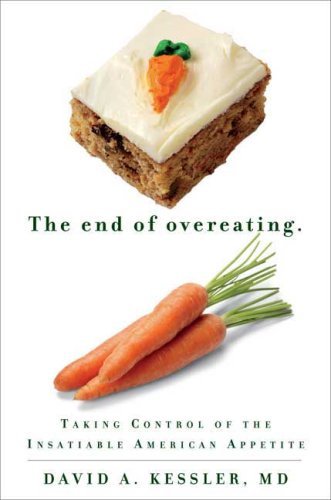
I remember when David Kessler became head of the FDA when I was in middle school. As an MD with a JD, he was a model for combining policy interests with scientific knowledge of health. In my middle school judgement, I found what he said incredibly sensible and just plain smart, and I decided that I should also get an MD/JD so I could grow up to be David Kessler.
Middle school judgements are sometimes exaggerated, but his book The End of Overeating does not disappoint in terms of the breadth of information that it tries to integrate. Kessler combines both human and animal research, frank and sometimes shocking conversations with food consultants revealing the secrets of increasing consumption (e.g., soft drink companies attempting to induce people to drink less water), and a food travelogue to create a compelling story to explain American obesity. For instance, Kessler discusses methods of food manufacture that causes processed restaurant chain food to break down the protein structure of meat and inject marinade so that it can be consumed more quickly than standard meat.
One of his central points is that sugar, salt, and fat combine to make food compelling ("hyperpalatable"), but he treats these elements as if they are interchangeable, but all hyperpalatable foods that he gives as examples have elements with a high glycemic index (breading, sugar, etc.) and the nutrition literature recognizes a distinction between fat and sugar. For instance, rats will overeat on pure sugar, pure fat, and sugar/fat mixtures, but only fat or sugar/fat mixtures increases weight but rats don't gain weight on sugar (one area in which they're clearly different from people --- witness the Snackwells effect which he mentions as well). Rats have few problems discontinuing fat, but discontinuation from sugar causes withdrawal symptoms similar to opioid withdrawal. (Avena NM, Rada P, Hoebel BG. Sugar and fat bingeing have notable differences in addictive-like behavior. J Nutr. 2009 Mar;139(3):623-8. Epub 2009 Jan 28.)
His theory and examples are also disjointed from each other. To bolster his claim that sugar alone is not enough to create hyperpalatability, he describes experiments in which people find skim milk with sugar added unpalatable but really like cream with sugar added, but then he contradicts this theory by describing his own struggles that lead him to eat an entire box of Snackwells fat-free cookies in a short period.
A theory based on macronutrients has extreme limits. While he does talk about flavor with food consultants, he doesn't incorporate flavor into his theory; obviously flavor is complicated. In a few places he says that obviously sugar in the absence of fat isn't a problem because people aren't eating sugar straight out of the bag, not considering that it's not exactly common to see people drinking oil out of the bottle or eating sticks of butter. Flavor is of course the important moderator: people will eat large numbers of meringues, jelly beans, angel food cake, Snackwell cookies, and all sorts of high calorie fat free foods, just as they will eat bacon (and I can't think of any other examples of fatty foods that derive nearly 100% of their calories from fat, to be comparable to jelly beans). An interesting counterpoint would be if he performed experiments in which he tested consumption of food in the absence of flavor, such by wearing noseplugs, as Seth Roberts has experimented with on a small scale.
He makes some strange claims about people historically eating low-fat meat and cites USDA data that people eat more fat than ever before, though other USDA data says that fat consumption has decreased since the 1970s and only sugar consumption has increased.
The book's chapters were short and did not tie together well, so his argument came off as more simplistic and repetitive than if he had written longer chapters that would have necessarily tied his argument together well. Even the short chapters sometimes ended abruptly. For instance, he has a chapter about Cinnabon, the 730 calorie pastry (sidenote: I remember from the only time I had a Cinnabon sometime in middle school that it had 500 calories and being horrified; I decided to check that calorie count again, and in fact now it's 730. Now that 500 calorie cookies are common, Cinnabons had to become 50% larger than before!) He interviews the creator of the Cinnabon and reveals that she had second thoughts about her creation, echoing Cookie Monster's refrain that "cookies are a sometimes food", and that she had created the Cinnabon to be a treat. He adds in a tantalizing last detail that she used to suffer from eating disorders and was unable to distinguish hunger from other needs, but then he ends the chapter abruptly without relating her eating disorder to her second thoughts about having created the Cinnabon.
The chapters about how to resist food are not new and have been covered better elsewhere such as in Brian Wansink's Mindless Eating as well as of course in the literature.
The book does add to the plausible explanations for the rise of obesity in the US, and it's well worth taking an afternoon to read this book. The quotes from food consultants about how to create "irresistible" and multi-layered "eating experiences" ("eatertainment") were especially revealing of the great deal of effort food companies have exerted to produce American obesity.
Tuesday, July 15, 2008
How to communicate weight loss messages to patients
A college friend of mine wrote in her live journal about her reaction to a doctor's initiation of the topic of weight at an appointment she had to address a recent injury. The doctor's approach seemed to be attempting to be non-intrusive: she gave a neutral factual statement that my friend looked from a picture like she used to be lighter. What happened next was interpreted as my friend as "asking if I knew I was going to DIE OF THE FAT."
Clearly something went wrong here in the immediate clinical encounter. Probably the doctor should have sensed from the conversation that my friend wasn't terribly open to discussing the subject and found it intrusive, especially since weight was completely irrelevant to the purpose of the appointment. If the doctor didn't want to just let the subject drop, she could have at most asked neutrally how she felt about that difference, and let it drop when my friend said that she felt fine.
But there's a larger question: how do physicians manage to acknowledge fat acceptance, but also send a message of obesity prevention?
Contrary to the blog comments, research is clear that on average mortality increases monotonically with BMI. Walt Willett's book has some nice plots of this. Fertility decreases monotonically with BMI. Even if recent research showing mortality improvements for some diseases in the BMI range 25 to 29 is completely free of confounding, so it's the weight which is associated with the decreased mortality rather than another factor that wasn't adequately adjusted for, it's only for a few of the evaluated diseases and mortality is much higher for BMI over 30.
Not to belabor the obvious, but these studies can only be refuted by studies of similar validity. They're not a massive conspiracy against anyone. They're just what the data revealed. Anyone who wants to reexamine the data to find a better explanation or find deemphasized null findings within the reports is free to do so, but so far no one has. And it's not impossible. See this reexamination of Framingham Heart Data on diet and cholesterol.
Anecdotes about outliers are just that. The studies hold on average, and while no one likes to think of themselves as average, all of us are average in most domains of life.
How can the overriding medical evidence be communicated in this sensitive way? I don't know, but here are some stabs at some of the issues:
- Many people feel powerless to change their weight, or feel that only heroic efforts can be successful. There does seem to be such a thing as a weight setpoint which is clearly resistant to change, see e.g. Gina Kolata's book.
- If it's not possible to change weight and live one's life in what one feels as a reasonable way, it makes a great deal of sense to accept weight as a given, and to see messages about overweight as taunting from people who just don't understand. Especially since sometimes they are.
- A never-overweight person sees their entire relationship with food, hunger, meals, clothes, and society completely differently and may therefore say stupid things like "Just lose weight," when it's anything but "just." Even the statements like "even 10 pounds makes a difference" while well-intentioned don't entirely help. One of the nicest but perennially thin people I know once said, "you're not that fat."
- It's not that easy, but it's usually not impossible either. In the spirit of self-discovery and self-experimentation while attaching no emotional weight to the results, people can design tests of the many approaches to food and diet, a few weeks long for each, to see whether anything changes their relationship to food or their weight.
And there are so many: beyond the obvious popular ones, the support-group types, there's the most kooky-seeming and yet potentially most profound by Berkeley psychology professor Seth Roberts.
-Logically, of course, it's not possible to prove a negative; it's not possible for people to prove what they perceive as reality that "weight loss is impossible for me" or "weight loss is only possible for me at an unacceptably high physical or emotional cost." But honestly these questions of obesity prevention and fat acceptance have such high emotional content on both sides that it's hard to say that there's much logic left.
No answers here, but maybe useful questions come out of it.
Clearly something went wrong here in the immediate clinical encounter. Probably the doctor should have sensed from the conversation that my friend wasn't terribly open to discussing the subject and found it intrusive, especially since weight was completely irrelevant to the purpose of the appointment. If the doctor didn't want to just let the subject drop, she could have at most asked neutrally how she felt about that difference, and let it drop when my friend said that she felt fine.
But there's a larger question: how do physicians manage to acknowledge fat acceptance, but also send a message of obesity prevention?
Contrary to the blog comments, research is clear that on average mortality increases monotonically with BMI. Walt Willett's book has some nice plots of this. Fertility decreases monotonically with BMI. Even if recent research showing mortality improvements for some diseases in the BMI range 25 to 29 is completely free of confounding, so it's the weight which is associated with the decreased mortality rather than another factor that wasn't adequately adjusted for, it's only for a few of the evaluated diseases and mortality is much higher for BMI over 30.
Not to belabor the obvious, but these studies can only be refuted by studies of similar validity. They're not a massive conspiracy against anyone. They're just what the data revealed. Anyone who wants to reexamine the data to find a better explanation or find deemphasized null findings within the reports is free to do so, but so far no one has. And it's not impossible. See this reexamination of Framingham Heart Data on diet and cholesterol.
Anecdotes about outliers are just that. The studies hold on average, and while no one likes to think of themselves as average, all of us are average in most domains of life.
How can the overriding medical evidence be communicated in this sensitive way? I don't know, but here are some stabs at some of the issues:
- Many people feel powerless to change their weight, or feel that only heroic efforts can be successful. There does seem to be such a thing as a weight setpoint which is clearly resistant to change, see e.g. Gina Kolata's book.
- If it's not possible to change weight and live one's life in what one feels as a reasonable way, it makes a great deal of sense to accept weight as a given, and to see messages about overweight as taunting from people who just don't understand. Especially since sometimes they are.
- A never-overweight person sees their entire relationship with food, hunger, meals, clothes, and society completely differently and may therefore say stupid things like "Just lose weight," when it's anything but "just." Even the statements like "even 10 pounds makes a difference" while well-intentioned don't entirely help. One of the nicest but perennially thin people I know once said, "you're not that fat."
- It's not that easy, but it's usually not impossible either. In the spirit of self-discovery and self-experimentation while attaching no emotional weight to the results, people can design tests of the many approaches to food and diet, a few weeks long for each, to see whether anything changes their relationship to food or their weight.
And there are so many: beyond the obvious popular ones, the support-group types, there's the most kooky-seeming and yet potentially most profound by Berkeley psychology professor Seth Roberts.
-Logically, of course, it's not possible to prove a negative; it's not possible for people to prove what they perceive as reality that "weight loss is impossible for me" or "weight loss is only possible for me at an unacceptably high physical or emotional cost." But honestly these questions of obesity prevention and fat acceptance have such high emotional content on both sides that it's hard to say that there's much logic left.
No answers here, but maybe useful questions come out of it.
Subscribe to:
Posts (Atom)